Most new investors never think of silver first.
They picture gold bars stacked in vaults, the glittering standard of wealth, and assume that’s where every smart investor begins. But here’s the quiet truth: silver is often the smarter starting point, simpler, more affordable, and far less intimidating for beginners who want to learn how real assets work.
If you’ve ever looked at the markets and felt priced out, you’re not alone. The average person hears about silver only when prices surge or headlines warn of economic shifts. Yet for decades, silver has been the hands-on classroom of precious metals. It lets you start small, understand how value behaves over time, and build confidence in your decisions before making larger investments.
In 2025, Silver’s story is more relevant than ever. Its unique balance of industrial demand (used in solar, electronics, and medical tech) and its traditional role as a store of value give it resilience that few other assets can match. Analysts note that silver’s price often lags gold in the short term but tends to outperform in early recovery cycles, making it particularly attractive for those beginning their investing journey.
Unlike speculative assets or digital trends, silver is something you can hold, weigh, and understand. It’s not about chasing quick profits; it’s about learning to protect your future with something tangible.
Over the next few sections, we’ll walk through how silver fits into a modern portfolio, the easiest ways to buy it, and what common pitfalls to avoid. Whether your budget is $100 or $1,000.
By the end of this guide, you’ll understand why investing in silver for beginners can be an easy, affordable, and confidence-building way to start growing your wealth. It’s one of the most practical first steps you can take toward financial stability.
If you’ve noticed silver returning to the conversation, there’s a good reason. After several quieter years, silver has regained attention not because of short-term hype, but because its importance in everyday industries continues to grow.
Silver is more than a store of value. It plays a critical role in modern technology, including solar panels, electronics, electric vehicles, and medical equipment. Industrial demand has remained strong as clean-energy manufacturing expands, while investment interest in physical silver continues to hold steady. That combination of practical use and investment demand makes silver unique among precious metals.
For investors, this matters because it changes the long-term case for owning silver. People are no longer buying silver only as an inflation hedge. Many investors now see it as a tangible asset supported by real-world demand across multiple industries. At the same time, silver remains far more accessible than gold. Its lower price point allows beginners to gain hands-on investing experience without committing large amounts of capital upfront.
But one of silver’s biggest advantages for new investors is psychological. Silver encourages patience. It rarely attracts people looking for overnight gains, and that can be a strength. Learning to invest in physical assets over time helps beginners focus less on short-term price swings and more on long-term value, discipline, and ownership.
As markets shift and headlines change, silver continues to stand out for a simple reason: it remains one of the most practical and accessible hard assets available to everyday investors.
Before diving into charts or dealers, it helps to understand what silver actually is as an investment. You’re not buying a stock certificate or a promise; you’re buying a physical element that has held value for more than four thousand years.
Yet it’s also part of the world’s most advanced technologies. That mix of ancient reliability and modern utility is what makes silver so distinctive.
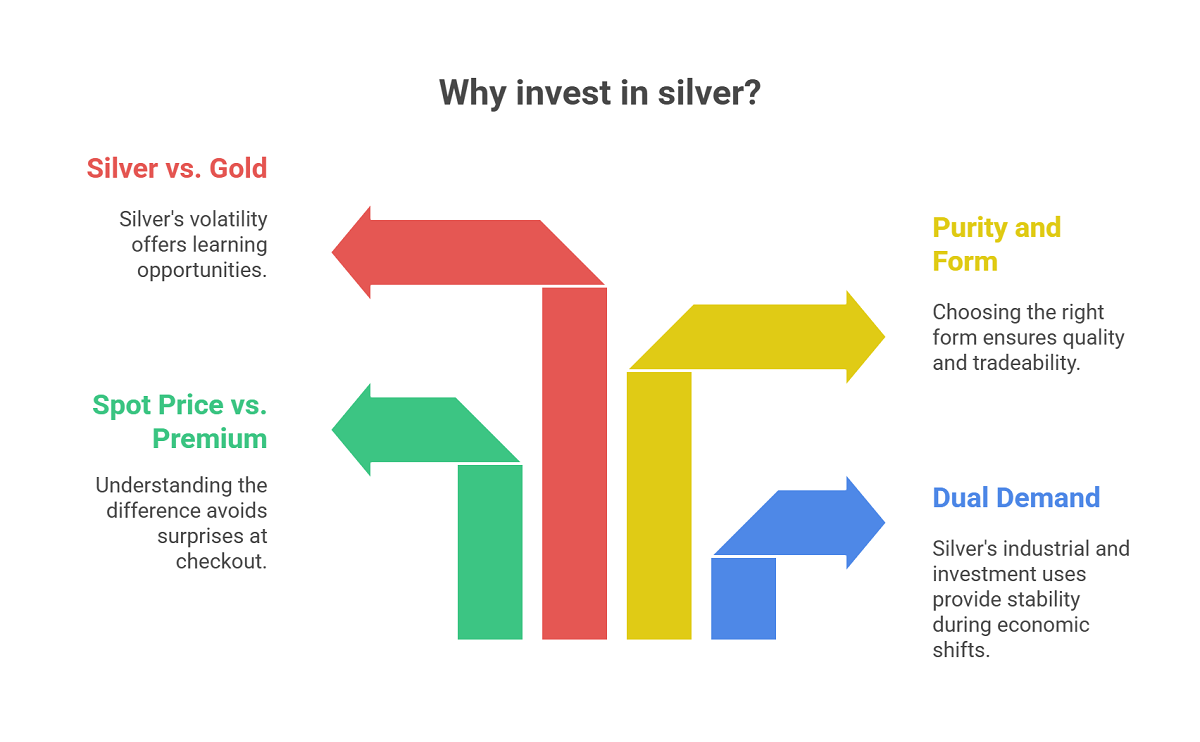
Silver has what professionals call dual demand.
Because silver serves both worlds, it often weathers economic shifts better than assets tied to only one market force.
The spot price is the global trading value of one troy ounce of pure silver (.999 fine).
When you buy physical silver, you’ll pay a little more (the premium), which covers refining, minting, and dealer costs. Understanding that difference helps beginners avoid surprise or suspicion when they notice a few extra dollars per ounce at checkout.
Most investment-grade silver comes as .999 fine bullion, meaning 99.9 percent pure. You’ll see it stamped on coins and bars along with the mint mark and weight.
Common forms include:
Think of gold as the quiet store-of-wealth older sibling and silver as the active, learning-by-doing younger one.
Gold moves slowly and stores large value; silver moves faster in percentage terms, teaching beginners how supply, demand, and sentiment interact. Its lower price per ounce means you can practice buying, holding, and even reselling without risking large sums.
In short: When you buy silver, you’re learning how value works in its most physical form. You’re holding a slice of global industry and centuries-old trust in your hand, something both modern and ancient that can teach you more about real wealth than any screen ever could.
One of the most common questions new investors ask is, “What’s the best way to own silver?”
The honest answer: there isn’t just one. Each method has its own strengths, trade-offs, and level of involvement.
Your goal as a beginner isn’t to find the “perfect” way; it’s to choose the approach that helps you learn while protecting your budget.
This is where most beginners should start. Owning physical silver gives you a real sense of control and understanding. You can see it, hold it, and watch how its value changes over time.
Pros:
Cons:
Start with well-known coins like the American Silver Eagle, Canadian Maple Leaf, or Britannia. These are recognized worldwide and easy to resell. Avoid rare or collectible coins until you’re comfortable with the basics; rarity adds complexity you don’t need yet.
Exchange-Traded Funds (ETFs) allow you to invest in silver without physically holding it.
These are shares that represent ownership of silver held by a custodian, often used for convenience or portfolio diversification.
Pros:
Cons:
These are best for investors who want exposure to silver’s price but aren’t ready for storage or physical handling yet.
You may see references online to silver futures, contracts, or margin trading. These are advanced tools that allow traders to speculate on future price movements, often using borrowed funds.
Here’s the truth: these are not beginner tools. They can amplify both gains and losses, and even experienced investors use them with extreme caution. For a first-time investor, they add unnecessary stress and risk that can undermine confidence before you’ve even learned the fundamentals.
So, skip them for now. You can always explore advanced products later once you’ve built a solid foundation through physical or ETF exposure.
Unfortunately, counterfeit coins and overhyped “limited editions” exist.
Here’s how to stay protected:
If you’re unsure, reach out for an independent verification before purchasing. At P&F Coin, education always comes before transactions; that’s what keeps first-time investors confident and secure.
The best silver investment for beginners is the one that teaches without overwhelming. Start small, learn with physical silver, explore ETFs as your knowledge grows, and leave advanced trading for later.

Buying silver for the first time shouldn’t feel like a leap; it should feel like a lesson.
You don’t need thousands of dollars or a financial degree. What you need is a simple plan that helps you gain experience one small, smart step at a time.
This section isn’t a recommendation of what you must buy, it’s a framework for learning how silver fits into your life and budget.
If you’re just beginning, this tier is about confidence, not collection.
Even one coin teaches you the rhythm of the market, how small changes in price feel and why long-term patience matters.
Once you’ve gained comfort, expand slightly.
At this stage, consider experimenting with both online and local purchases to learn how each transaction feels delivery times, packaging, verification, and customer service.
Here, you’re moving from experimenting to organizing.
You don’t learn faster by spending more. You learn faster by being consistent, buying small amounts regularly, and observing how your comfort grows. Dollar-cost averaging works beautifully with silver. It removes timing stress and turns your buying into a habit of learning, not guessing.
The goal isn’t to own the most silver, it’s to understand it. Start where you are, stay curious, and let knowledge compound just like ounces do. When you start small, you’re not just buying silver. You’re buying experience and that’s the foundation of every confident investor.
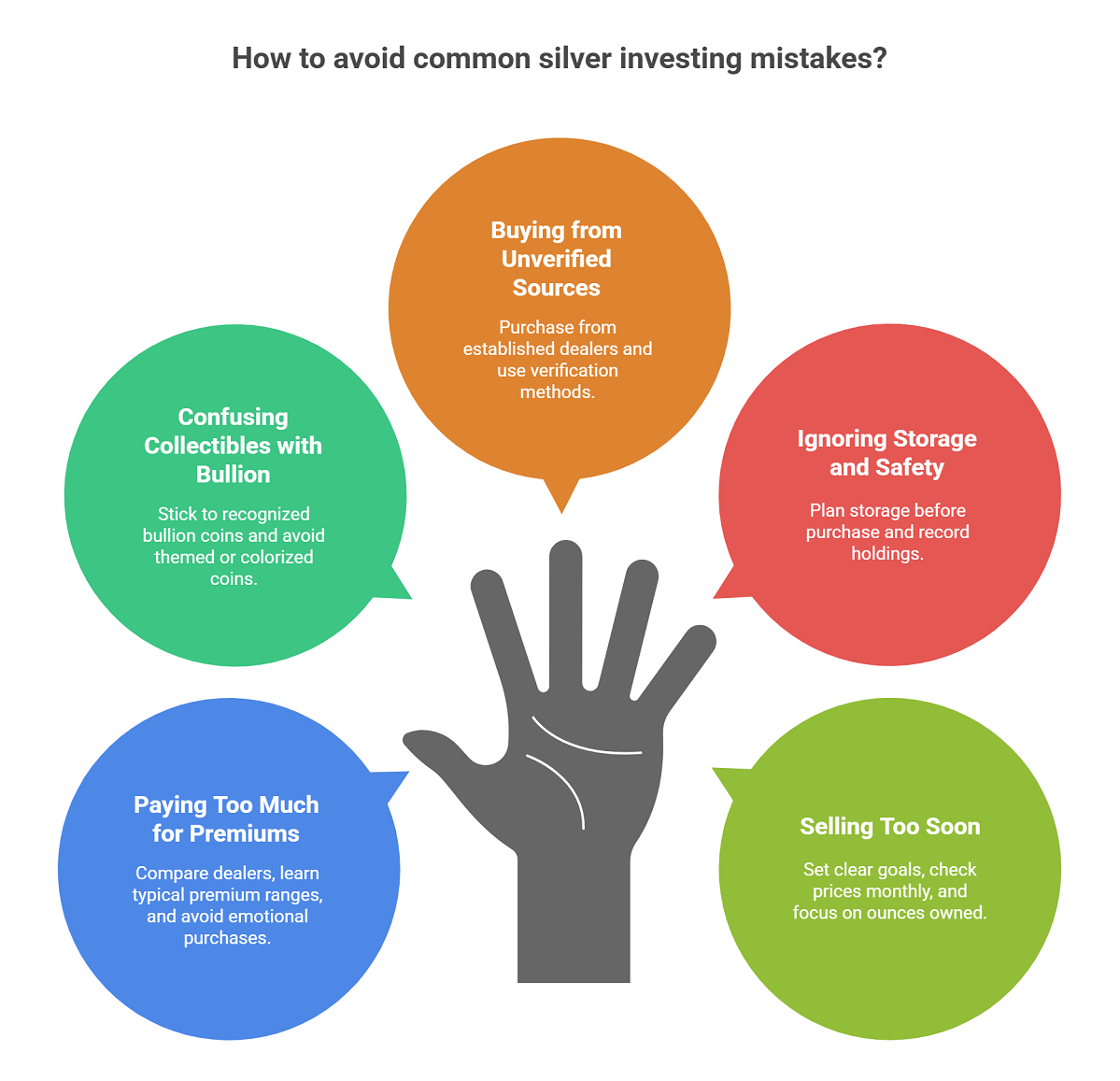
Every new investor makes small errors. That’s how we learn. The problem is when those mistakes involve money, trust, or safety. Silver, being tangible, adds an extra layer of responsibility. The good news is, every beginner can avoid major missteps with a little preparation and patience.
Below are the five most common mistakes beginners make when investing in silver and how to steer clear of them.
This is the most frequent (and most preventable) error. The spot price is what silver trades for on the global market. The premium is what dealers add to cover minting, distribution, and profit.
Avoid it by:
Remember: a good dealer educates first. They should be transparent about what you’re paying for, not just what you’re buying.
Many beginners see shiny, limited-edition coins and assume rarity equals value. But unless you’re a collector, that premium rarely translates to resale worth.
Avoid it by:
If you can’t explain why something costs more, it’s not a good fit for your first year of investing.
Online marketplaces and social media listings can offer tempting prices, but counterfeit silver is real and often convincing.
Avoid it by:
If you ever feel uncertain, pause. There’s no deal so urgent that it can’t wait for confirmation.
Silver is physical, and that’s part of its charm. But it’s also a responsibility. Too many first-time investors buy ounces, then realize they have no plan for where to keep them.
Avoid it by:
Treat your silver the way you’d treat important documents: accessible, protected, and private.
Silver can be emotionally tricky. Beginners often sell when prices dip, only to watch the market recover later. Remember, this is a learning journey, not a short-term trade.
Avoid it by:
Patience is a skill, and silver is one of the best teachers of it. Silver investing rewards those who slow down, learn, and verify. Mistakes happen when we rush or follow excitement instead of understanding.
At P&F Coin, we believe education is the most valuable metal you can own because once you understand how silver works, the rest comes naturally.
It’s one of the oldest investing questions there is: Should I start with silver or gold?
Both metals have stood the test of time. Both are respected stores of value. But the right answer depends less on which is “better” and more on where you are in your investing journey.
Let’s look at how they truly compare, especially from a beginner’s perspective.
This is where silver shines for first-time investors. While gold often trades above $2,000 per ounce, silver usually sits between $20 – 30 per ounce, making it roughly one-hundredth the cost for the same weight.
That lower price point allows you to start small, learn by doing, and gain comfort with buying, holding, and storing tangible assets, all without risking large sums. In short: gold protects wealth you’ve already built; silver helps you start building it.
Silver moves more dramatically in price than gold, both up and down. While that can make headlines sound dramatic, it’s actually a hidden benefit for beginners. Small price swings teach you how markets behave, how emotion influences decisions, and how patience pays off.
Gold, by contrast, is calmer. It’s designed for preservation, not practice. That’s why seasoned investors often hold more gold later, once they understand how metals fit into their long-term plan.
Both metals are easy to store, but silver takes up more room for the same dollar value. A thousand dollars of silver is noticeably heavier and bulkier than the same amount in gold.
For new investors, that can actually be useful. You can physically see and feel your progress, which builds confidence.
Over time, as your holdings grow, you might consider adding gold for compactness and higher-value storage efficiency.
This factor often goes unspoken, but it matters.
Silver attracts learners who want to understand what they own.
Gold attracts preservationists focused on long-term wealth security.
Neither is wrong. But for beginners who are still testing their confidence, silver’s lower cost and tactile learning make it a more natural first step. It’s the difference between learning to drive in a calm neighborhood versus jumping straight onto the highway.
The best portfolios don’t treat silver and gold as competitors; they complement each other.
A simple rule of thumb some investors use is starting with silver for education and affordability, then gradually adding gold for stability and legacy.
That way, you’re learning as you build, not gambling, not rushing, just growing at a pace that feels right. Gold preserves, silver teaches. Start with the metal that helps you understand value first, not just store it.
When the time comes, combining both gives you the best of both worlds: silver’s accessibility and gold’s permanence, a partnership as old as money itself.
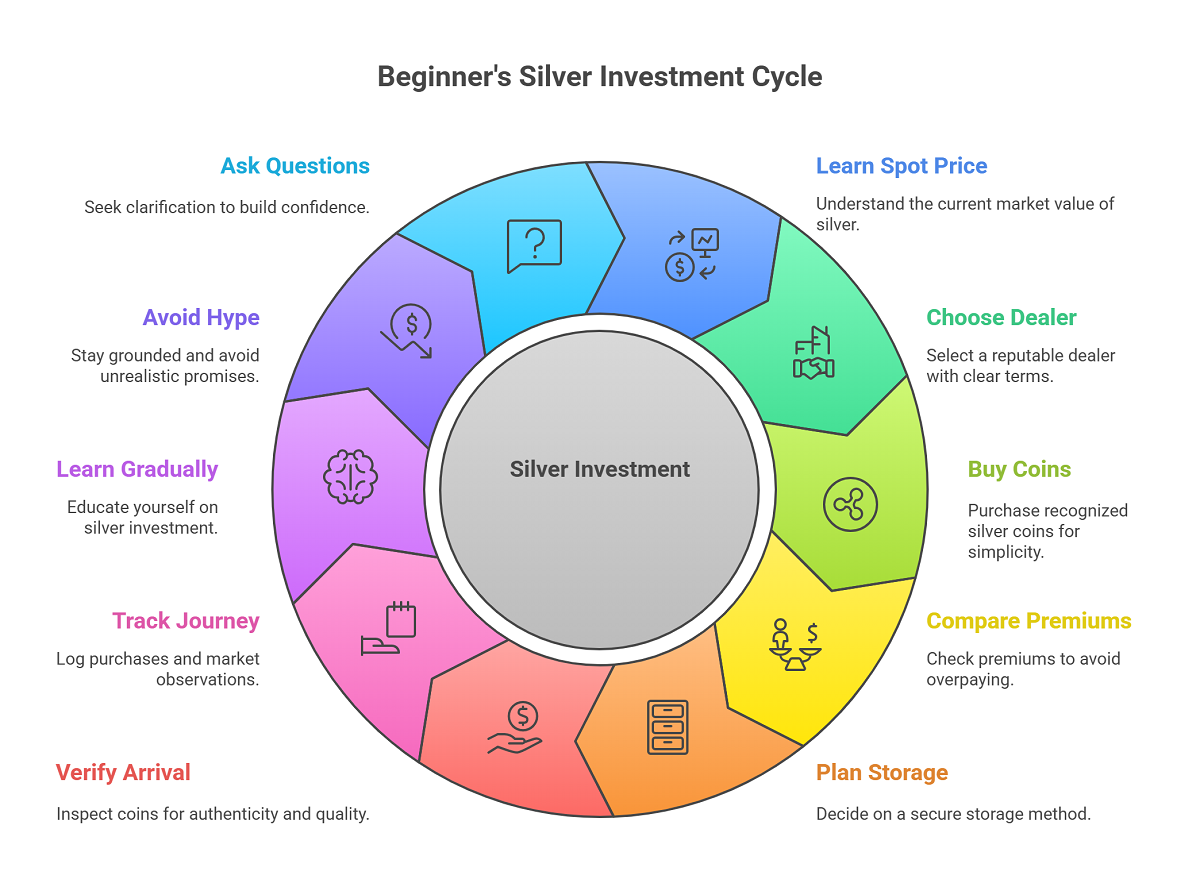
When you’re new to investing, it’s easy to get lost in information. So let’s simplify everything you’ve learned into one quick, practical checklist. Take ten quiet minutes, a notepad, and your curiosity. That’s all you need to begin your journey with confidence.
Before you buy anything, look up the current silver spot price on a trusted financial site or reputable dealer page. It’s the baseline value for one ounce of pure silver and helps you recognize a fair deal.
Stick with established names that clearly show their premiums, reviews, and years in business.
If something feels off or overly urgent, walk away. A good dealer respects your pace.
For your first purchase, simplicity beats variety.
Choose globally recognized coins such as:
Each is .999 fine silver, easy to verify, and highly liquid.
Check two or three dealers to see the difference between spot price and total cost. Understanding premiums early will save you from overpaying later.
Even a single coin deserves a safe home.
Decide between:
Record what you own and where you keep it. This is part of becoming a responsible metals holder.
When your silver shows up, inspect it carefully. Look for clear weight and purity markings (.999 fine), consistent packaging, and reputable mint marks. You can also do a quick magnet or weight test real silver is non-magnetic and has a distinct sound when tapped lightly.
Create a simple log: date purchased, weight, cost, and notes. This builds awareness and replaces anxiety with insight. Over time, you’ll see your learning and your collection grow together.
Don’t rush to diversify. Spend time understanding what you own. Watch how prices move over months, not days, and read beginner-friendly articles or videos about silver’s role in modern finance.
If someone promises “guaranteed returns,” it’s not education, it’s persuasion. Silver’s strength lies in steadiness and realism. Stick with facts, history, and your own goals.
Every smart investor started by asking one. At P&F Coin, we encourage questions before purchases because confidence is built through understanding, not urgency.
The first step isn’t buying silver, it’s knowing what matters. Once you follow this checklist, you’ll understand more about value, patience, and responsibility than most people who’ve been investing for years.

If you’ve read this far, take a quiet moment to appreciate something important: You now understand more about silver than most first-time investors ever do before making their first purchase. You’ve learned what silver is, why it matters in today’s economy, and how to begin safely and confidently.
But more than that, you’ve learned how to think like an investor. That shift is what separates panic from patience, and hype from wisdom.
Silver teaches discipline.
It doesn’t move at the speed of headlines or social media; it moves at the speed of time and trust. It reminds us that real value isn’t built overnight, and that small, consistent steps one coin, one ounce, one habit at a time, can quietly transform the way we see wealth.
For many, that first ounce isn’t just metal. It’s proof. Proof that they can take control of their own education, act intentionally, and own something real.
You don’t have to predict prices or beat the market. You just need to understand why you’re investing and what role silver plays in your personal plan. The rest will follow naturally.
At P&F Coin, we believe financial confidence begins with knowledge. Whether you buy today, next month, or next year, what matters is that you feel informed, steady, and clear. That’s the foundation every long-term investor deserves.
Silver isn’t just an asset; it’s an education. Start small, stay curious, and let understanding compound over time. If you ever want help interpreting the next step, whether that’s comparing coins, storage options, or just clarifying your plan, Contact Us for a no-pressure, educational conversation. When you invest with confidence, not fear, every ounce becomes a reflection of something bigger: progress built on purpose.