Palladium is a rare precious metal used heavily in automotive, electronics, and industrial manufacturing. In recent years, investors have become increasingly interested in palladium because of its limited global supply, industrial demand, and potential role as a diversification asset alongside gold and silver.
Unlike more traditional precious metals, palladium prices are influenced heavily by manufacturing demand and global supply constraints. That combination can create both investment opportunities and higher volatility.
In this guide, you’ll learn what palladium is, why investors buy it, how palladium investing works, and the risks and benefits of adding palladium bullion to a precious metals portfolio.

Palladium is a rare, silvery-white metal that belongs to the platinum group metals (PGMs), which also include platinum, rhodium, ruthenium, iridium, and osmium. Though it might not be as familiar as gold or silver, palladium plays a vital role in today’s world, and its combination of industrial demand, scarcity, and investment potential is what makes it increasingly attractive to modern investors.
Discovered in 1803 by English chemist William Hyde Wollaston, palladium was named after the asteroid Pallas. For most of its early history, it remained in the background, quietly used in scientific instruments, dental work, and later, in catalytic converters. But over the last two decades, it has stepped into the spotlight especially as emissions standards tightened worldwide, forcing the auto industry to rely heavily on palladium’s unique properties.
Palladium’s physical and chemical traits make it both useful in industry and valuable as a precious metal. It’s not just shiny, it’s functional.
Most people don’t realize how many modern technologies depend on palladium. Its largest application, by far, is in automotive catalytic converters, where it helps clean exhaust gases by converting harmful pollutants into less toxic substances.
Here are the top current uses:
| Use Case | Description |
| Automotive | ~80% of demand; catalytic converters in gasoline engines |
| Electronics | Used in capacitors, circuit boards, and connectors |
| Jewelry | Hypoallergenic alternative to white gold or platinum |
| Dentistry | Occasionally used in dental alloys and fillings |
| Hydrogen storage & fuel cells | Palladium can store hydrogen important for future clean energy |
With ongoing interest in green technologies and tightening emissions regulations, many experts believe palladium will continue to be in high demand especially in countries pushing harder on climate targets.
Since both palladium and platinum belong to the same metal group and have overlapping uses, they’re often compared. Here’s how they differ:
| Feature | Palladium | Platinum |
| Price (2025) | Often higher due to tighter supply | Historically higher, but recently lower |
| Density | Lighter | Heavier |
| Appearance | Silvery-white | Silvery-white (slightly darker) |
| Industrial Use | Primarily gasoline engines | More common in diesel engines |
| Jewelry | Gaining popularity | Traditional high-end metal |
While platinum is still popular, palladium’s price and performance in catalytic converters have made it the more in-demand metal in recent years especially as diesel engine use declines globally.
Investors and collectors alike are starting to recognize palladium not only for its scarcity and utility but also for its role in diversification. As we’ll explore in the next section, that quiet demand combined with constrained global supply is part of why investors are quietly buying palladium.
Gold has long been the darling of precious metal investors. Silver has its own niche as both an industrial and investment metal. But palladium? It’s the quiet outperformer that few outside the metals world were talking about until recently.
Over the last 10+ years, palladium’s value has surged, at times surpassing both gold and platinum in price. What’s driving that growth? A perfect storm of tight supply, soaring demand, and future-facing applications.
Let’s break it down.
The single biggest consumer of palladium is the automotive industry, which uses it to manufacture catalytic converters for gasoline-powered vehicles. These converters play a critical role in reducing harmful emissions like carbon monoxide and nitrogen oxide.
Even as electric vehicles (EVs) rise in popularity, hybrid vehicles still require catalytic converters. And despite EV growth, internal combustion engines will remain on the road for decades which means palladium isn’t going away anytime soon.
Unlike gold and silver, palladium is mined in only a few places worldwide, making its supply chain especially fragile.
Top Producing Countries:
Any disruption geopolitical tension, labor strikes, environmental regulation can cause supply shocks, spiking prices. This happened in 2022 when sanctions and uncertainty affected Russian palladium exports.
The reality is: Palladium is scarce, and demand keeps rising.
| Year | Average Price (USD/oz) | Notable Events |
| 2015 | $690 | Low demand; low visibility |
| 2019 | $1,540 | Automotive demand surges |
| 2020 | $2,190 | Supply chain issues, emission laws |
| 2022 | $2,100+ | Russia–Ukraine conflict impacts supply |
| 2025* | ~$1,200–$1,400 | current live spot prices align with this range but not yet final |
Estimates based on recent market data
Even with price corrections since its peak, palladium’s value remains significantly above its historical average, attracting both long-term investors and precious metal collectors.
While automotive use dominates today’s palladium demand, new technologies could fuel even more growth:
In short, palladium isn’t just riding a wave, it’s riding multiple waves across industries that are growing, evolving, and critical to the global economy.
If gold is the seasoned king of precious metals, palladium is its lesser-known but surprisingly powerful cousin, leaner, rarer, and tied to modern industry. For many first-time buyers, comparing palladium vs gold can feel like comparing apples to… a shinier, faster apple. So let’s break it down.
Both are precious metals. Both can store value. But their roles in a portfolio, volatility, and demand cycles are very different.
| Feature | Gold | Palladium |
| Use Case | Investment, jewelry, central banks | Industrial (cars, tech), some jewelry |
| Price Stability | More stable, slow-moving | More volatile, spikes with demand shocks |
| Liquidity | Highly liquid, globally traded | Less liquid, niche market |
| Historical Significance | Thousands of years as currency/store of value | Used industrially since 20th century |
| Supply Source | Mined globally | Concentrated in Russia & South Africa |
| Investment Options | Wide range: coins, bars, ETFs, IRAs | Limited coins/bars, few ETFs, no IRAs* |
| Appeal to Central Banks | High gold is a monetary reserve | Low not used as monetary reserve |
| Risk Level | Lower (store of value) | Higher (growth potential, but volatile) |
*Note: Some custodians offer palladium IRAs, but they are less common and may come with added fees or complexity.
So Which One Is Better? The truth is: it depends on your goals.
Choose Gold if you want:
Consider Palladium if you want:
You don’t have to choose one over the other. Many thoughtful investors including your more experienced clients use palladium as a diversification layer within their precious metals portfolio.
Think of gold as your foundation. Palladium is your “growth lever.” Together, they allow you to hedge and grow at the same time.
“I was surprised how well palladium complemented my gold holdings. It reacts differently to market shifts, which helped me feel more balanced overall.”
— A New Investor testimonial (ideal insert for trust & relatability)
At P & F Coin, we don’t believe in hype or hard sales. We believe in showing you the facts, helping you weigh your options, and letting you decide what makes the most sense at your own pace.
If you’re considering adding palladium to your existing gold holdings, we’re happy to walk through what that might look like, based on today’s market trends and your goals.
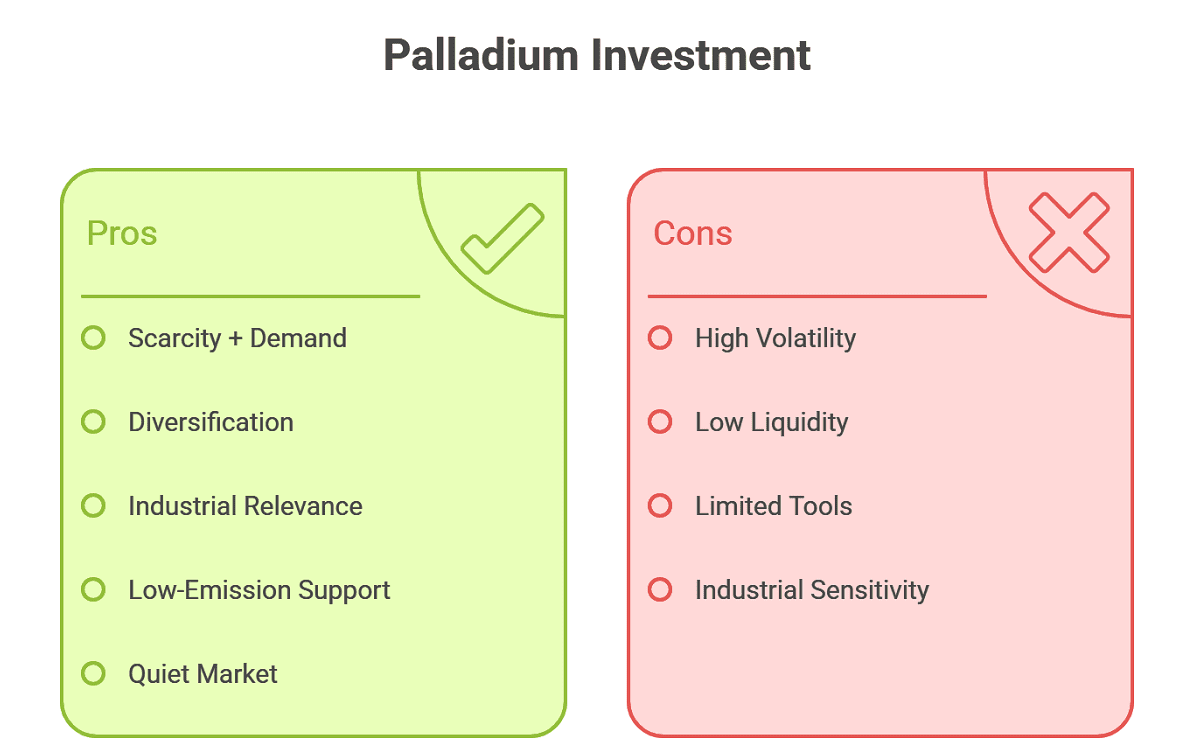
Let’s get honest: palladium isn’t for everyone. It’s not the most talked-about precious metal. It’s more volatile than gold or silver. And it doesn’t have the centuries old emotional history of gold, or the affordability of silver.
But for certain investors in 2025 especially those looking for tangible diversification and exposure to future-facing industries palladium might be the quiet power play worth considering.
Several converging factors are shaping how investors view palladium this year:
1. Continued Demand from the Auto Sector
Despite growth in electric vehicles (EVs), gasoline and hybrid vehicles still dominate global roads especially in North America and Asia. These vehicles require catalytic converters, and palladium remains a primary component due to its superior emission reducing properties.
2. Green Energy Innovation
Palladium is being explored in hydrogen fuel cell technology, which is gaining attention as countries look beyond lithium batteries. As clean energy investment ramps up, demand for palladium could expand into entirely new sectors.
3. Supply Risks and Global Uncertainty
With Russia and South Africa controlling the majority of palladium supply, any disruptions (like sanctions, labor strikes, or geopolitical tension) can spike prices quickly, something we saw in 2022 – 2023.
4. Lower Spot Price (Relative to Recent Highs)
After hitting peaks above $2,000/oz in recent years, palladium prices have cooled, hovering between $1,200 and $1,400 in 2025. For some, this is a buying opportunity, a chance to enter when prices are more approachable.
So… Is Palladium “Good” in 2025?
Here’s the honest answer: Palladium isn’t a core metal for most portfolios. But it might be a smart strategic metal.
If you’re a:
Palladium shouldn’t replace your core holdings, but it can enhance them. For the right investor, it offers a unique mix of rarity, relevance, and reward.
If you’re curious about whether palladium fits your goals whether it’s a $500 coin or a $5,000 bullion bar we’re happy to walk through your options. We’ll talk honestly about the benefits and risks, no pressure, no sales pitch.

So you’ve learned what palladium is, why it matters, and how it stacks up against gold. Now you’re wondering: “How do I actually invest in palladium?”
The good news is, you have options whether you’re a hands-on investor who wants to hold something tangible or someone who prefers a more passive approach.
Let’s break down the four main ways to invest in palladium with pros, cons, and guidance based on your goals.
This is the most direct and tangible form of investing in palladium. You’re buying real metal that you can hold in your hand, no paper, no proxies.
Types of Physical Palladium:
Pros:
Cons:
If you’re starting with physical palladium, we recommend beginning with 1 oz coins from trusted mints; they’re easier to store, sell, and verify.
If you’re more comfortable with traditional investing platforms, ETFs let you gain exposure to palladium prices without holding the metal itself.
Example:
Pros:
Cons:
Best for: investors looking for portfolio diversification who don’t want the logistics of physical metal.
Another option is to invest in companies that mine palladium, especially in Russia, South Africa, and Canada.
Pros:
Cons:
Best for: more experienced investors comfortable with equities and sector research.
For collectors or those looking for both value and meaning, rare certified palladium coins offer a dual benefit: they’re precious metal and collectible history.
Best for: passionate collectors, or those blending investing with legacy-building.
We often help collectors build portfolios that include rare palladium coins, a great conversation starter and long-term store of value.
Yes, but with caveats.
It’s less common than gold or silver IRAs, but worth considering for long term tax advantaged investing.
| Investor Type | Best Investment Type |
| New Investor | 1 oz government-minted coins or ETFs |
| Wealth Preserver | Physical bullion in secure storage |
| Numismatist | Graded palladium coins, historical value |
| Hands-off investor | Palladium ETF or IRA setup |
No matter which route you choose, start with what makes sense for your comfort level. You can always expand over time.
“Whether you’re looking to hold physical metal, diversify a retirement account, or simply learn the ropes, we’ll help you invest in palladium the way that fits you best.”
— The P&F Coin Team
Every investor has a reason for exploring precious metals. Some are just getting started, others are protecting what they’ve built, and a few are collecting for legacy and love of history.
Palladium might not be the first metal you think of but for each of these groups, it offers something meaningful.
Let’s look at how palladium fits into different investing mindsets.
“I’m just learning how all this works. Is palladium too advanced?”
Not at all. In fact, adding a small amount of palladium can be a smart way to diversify early especially if you already own gold or silver.
“New to gold? You’re not alone. We’ll walk you through your options, palladium included so you can protect what matters, one step at a time.”
I’ve done well but I don’t trust the market the way I used to.
If you’re focused on stability, legacy, and wealth protection, you already understand the importance of physical assets. Palladium offers a way to diversify your holdings beyond the usual suspects and tap into metals tied to future-forward demand.
“Your legacy deserves more than a guess. Let’s protect your portfolio with real, tangible assets, palladium included.”
“I’m not just investing, I’m preserving history.”
Collectors see value differently. It’s not just about ounces or spot price it’s about rarity, story, and certification. While palladium isn’t a classic numismatic metal, its limited coin production and rising profile make it a fascinating piece for the modern collection.
“Every coin tells a story. Palladium might just be the next chapter worth adding to yours.”
We don’t believe in one size fits all advice because your goals aren’t one size fits all.
Whether you’re just getting started or refining your legacy strategy, our team can help you explore how palladium fits into your overall portfolio. No pressure. No jargon. Just thoughtful, patient guidance built around your needs.
Palladium may not be as well known as gold or silver, but that’s exactly why some investors are paying attention. It’s scarce, industrially vital, and increasingly relevant in a world shifting toward clean energy and environmental responsibility.
Whether you’re just beginning your journey into precious metals or expanding a seasoned portfolio, palladium offers something different:
But like any smart investment, understanding matters more than hype. And that’s where we come in.
“At P&F Coin, our job isn’t to sell you palladium. It’s to help you decide if it belongs in your story, your plan, your collection, your legacy.”
If you’re curious, let’s talk. No pressure. Just real answers and honest options from bullion to rare coins so you can make the most informed decision possible.
You don’t have to be an expert. You don’t need to have it all figured out.
Whether you’re exploring precious metals for the first time or adding depth to a well earned legacy, we’re here to help you navigate it one honest conversation at a time.
Discover your options with palladium or reach out for a no pressure, real person consultation.
No gimmicks. No guesswork. Just clarity you can count on.